
Installation, Testing and Comparison
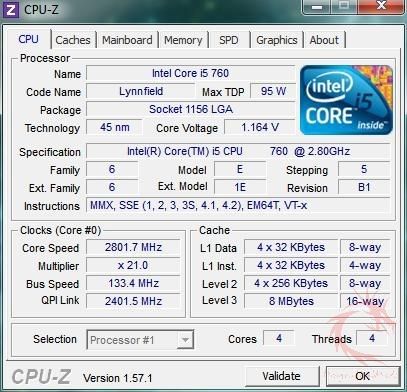
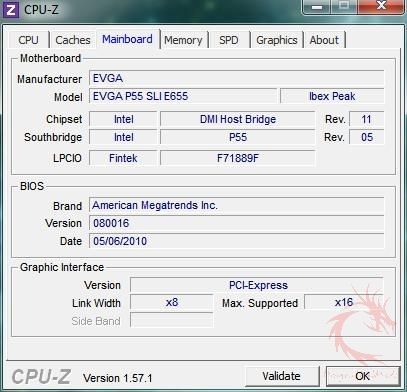
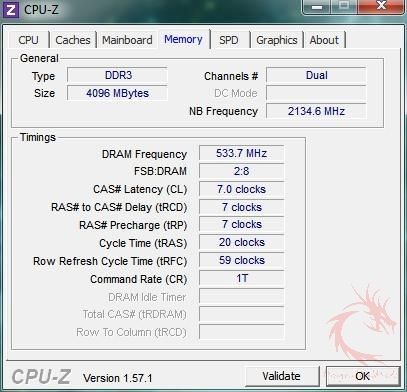
My socket 1156 motherboard is the EVGA P55 Sli and the ram I used for the testing is 4gb of Patriot Viper Xtreme Series DDR3 at 1600MHz. At the time I was using an ATI 4890 video card as well.
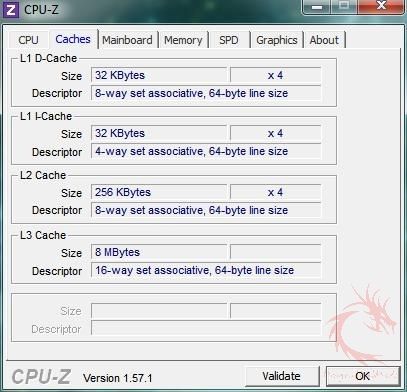
Here’s the CPU-Z screenshots of the CPU and system for you for information sake:
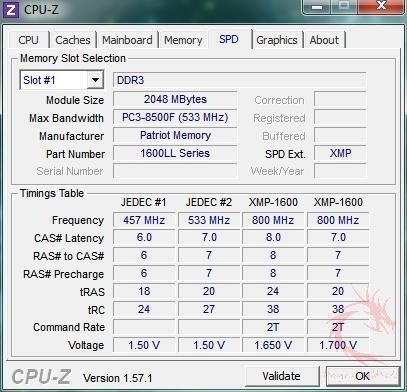
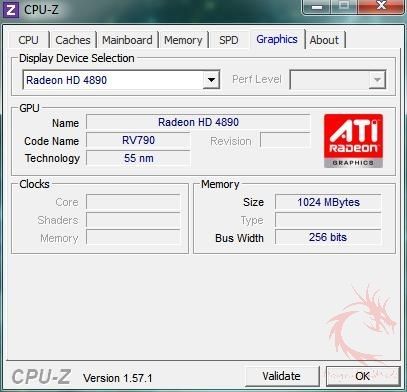
Let’s get into to testing and first up is a whole system test called CrystalMark which tests everything in the system really. Higher scores are better of course.
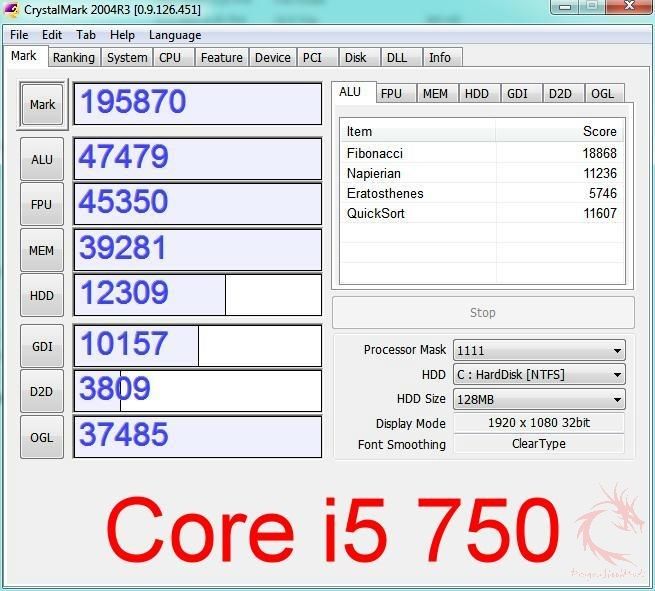
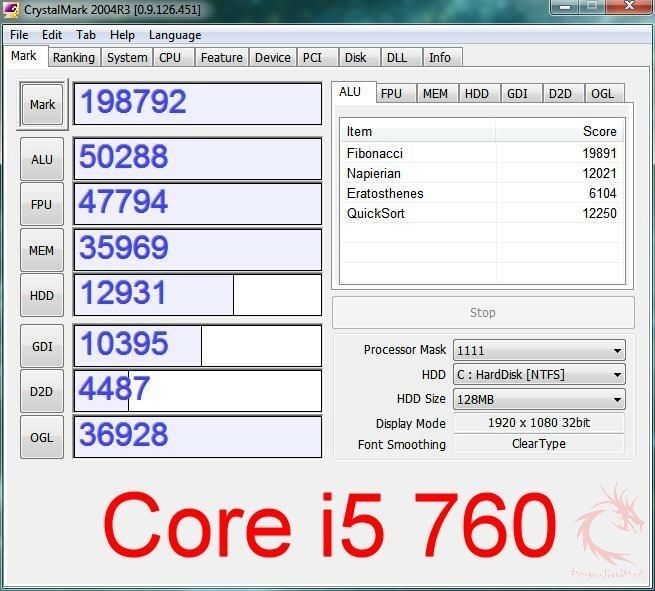
The overall score shows a slight improvement over the 750 but everything in the system is improved really it seems.
The next test is encoding using the x264 HD Benchmark 4.0 from Techarp
Core i5-750:
Pass 1
——
encoded 1442 frames, 97.63 fps, 3912.26 kb/s
encoded 1442 frames, 103.76 fps, 3912.26 kb/s
encoded 1442 frames, 102.63 fps, 3912.26 kb/s
encoded 1442 frames, 103.27 fps, 3912.26 kb/s
Pass 2
——
encoded 1442 frames, 19.88 fps, 3961.14 kb/s
encoded 1442 frames, 19.85 fps, 3961.52 kb/s
encoded 1442 frames, 19.90 fps, 3961.84 kb/s
encoded 1442 frames, 19.86 fps, 3961.85 kb/s
Core i5-760:
Pass 1
——
encoded 1442 frames, 108.99 fps, 3912.26 kb/s
encoded 1442 frames, 109.85 fps, 3912.26 kb/s
encoded 1442 frames, 109.30 fps, 3912.26 kb/s
encoded 1442 frames, 108.89 fps, 3912.26 kb/s
Pass 2
——
encoded 1442 frames, 21.30 fps, 3961.87 kb/s
encoded 1442 frames, 21.28 fps, 3961.38 kb/s
encoded 1442 frames, 21.31 fps, 3961.13 kb/s
encoded 1442 frames, 21.28 fps, 3961.54 kb/s
The 760 offers slightly faster FPS, but nothing amazing for sure.
The next test is Cinebench 11.5:
Main Processor Performance (CPU)
The test scenario uses all of your system’s processing power to render a photorealistic 3D scene (from the viral “No Keyframes” animation by AixSponza). This scene makes use of various different algorithms to stress all available processor cores.
In fact, CINEBENCH can measure systems with up to 64 processor threads. The test scene contains approximately 2,000 objects containing more than 300,000 total polygons and uses sharp and blurred reflections, area lights and shadows, procedural shaders, antialiasing, and much more. The result is given in points (pts). The higher the number, the faster your processor.
Graphics Card Performance (OpenGL)
This procedure uses a complex 3D scene depicting a car chase (by renderbaron) which measures the performance of your graphics card in OpenGL mode. The performance depends on various factors, such as the GPU processor on your hardware, but also on the drivers used. The graphics card has to display a huge amount of geometry (nearly 1 million polygons) and textures, as well as a variety of effects, such as environments, bump maps, transparency, lighting and more to evaluate the performance across different disciplines and give a good average overview of the capabilities of your graphics hardware. The result given is measured in frames per second (fps). The higher the number, the faster your graphics card.
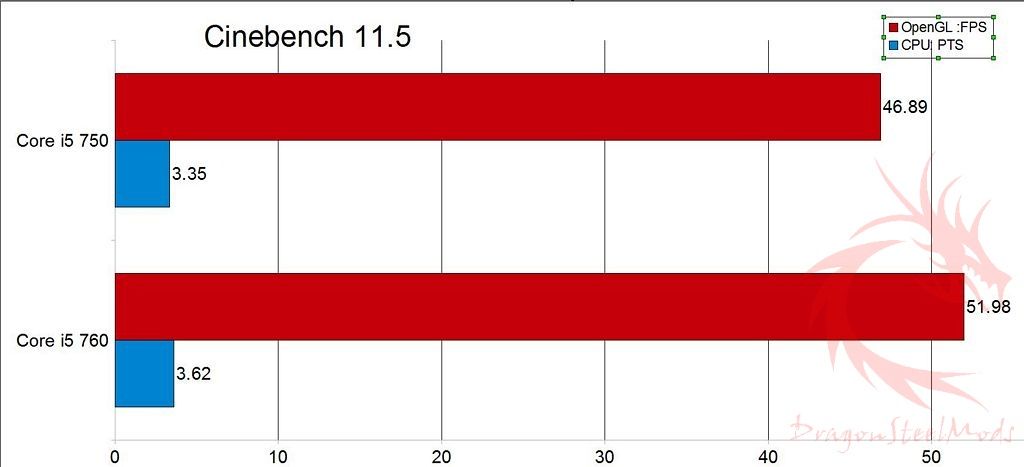
Again, there’s a slight improvement overall with the 760.
The next test is calculating Pi to 1 million places; I used Hyper Pi for this. Lower scores or times are better.
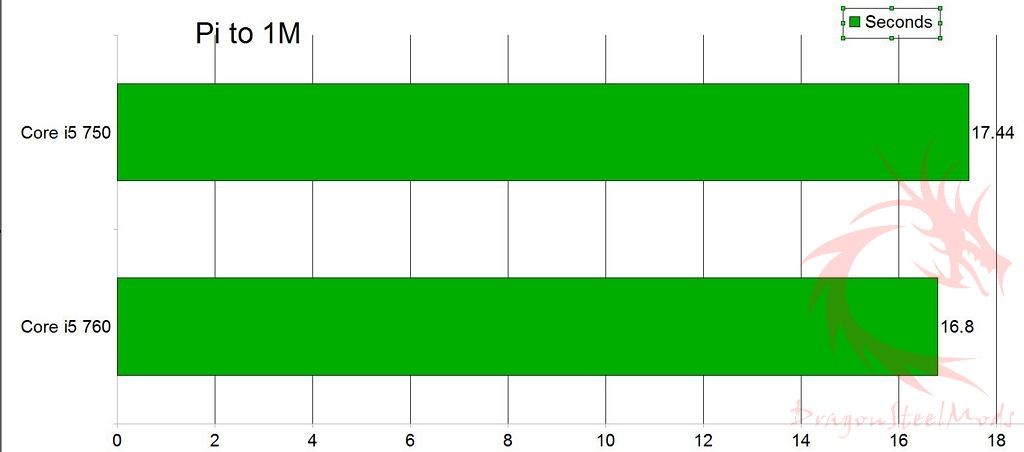
Here we see an improvement of slightly more than half of a second faster using the 760.
The last sets of tests are all using SiSoft Sandra 2010 Portable Edition.
We’ll start with the Cache and Memory test:
Cache and Memory Test:
Benchmark the processors’ caches and memory access (transfer speed).
Results Interpretation
Cache/Memory Bandwidth (MB/s) – higher results are better, i.e. faster memory bandwidth.
Speed Factor (MB/s) – lower results are better, i.e. less difference between processor cache speed and memory speed.
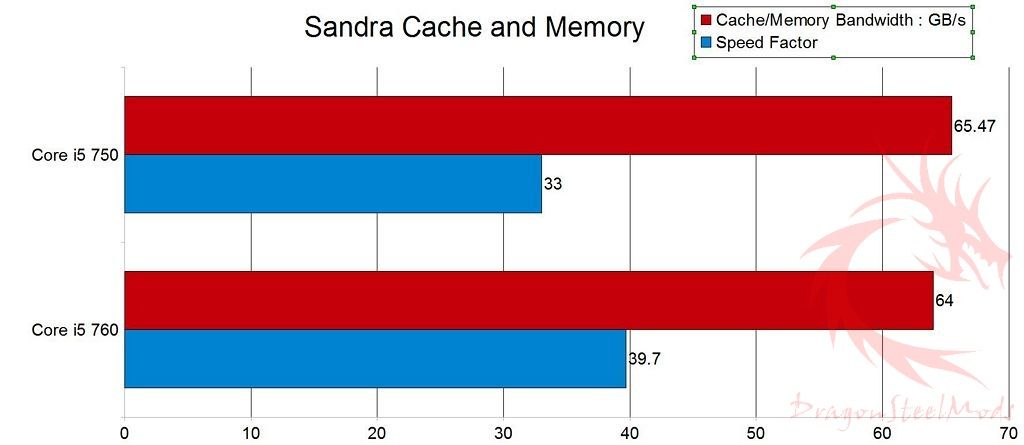
Here we see the 750 does better in both tests, something I wasn’t expecting at all. I was expecting the 760 to do the best in all of the tests.
The next test is CPU Arithmetic:
CPU Arithmetic Test:
Results Interpretation: Higher index values are better.
Benchmarks the ALU and FPU processor units
Results Interpretation
Dhrystone (MIPS) – higher results are better, i.e. better integer performance.
Whetstone (MFLOPS) – higher results are better, i.e. better floating-point performance.
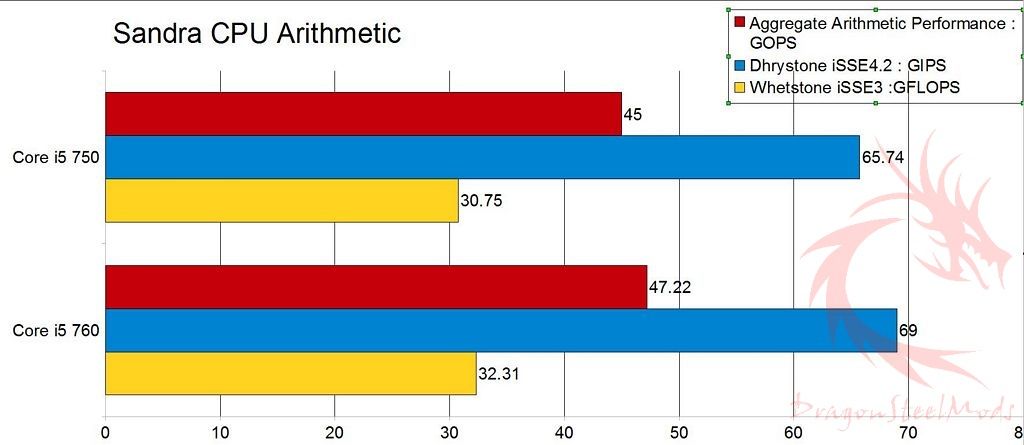
That’s more of what I was expecting, the 760 does better, and by quite a bit in terms of system level performance.
The next test would be CPU Multi-Media:
CPU Multi-Media Benchmark.
Results Interpretation : Higher index values are better.
Benchmark the (W)MMX(2), SSE(2/3/4), AVX processor units.
Results Interpretation
Multi-Media Integer (Pixels/s) – higher results are better, i.e. better integer performance.
Multi-Media Single/Double Float (Pixels/s) – higher results are better, i.e. better floating-point performance.

And again we see the 760 offers better performance here as expected.
The next test would be Memory Bandwidth:
Memory Bandwidth test:
Benchmark the memory bandwidth of your computer
Results Interpretation
Integer Memory Bandwidth (MB/s) – higher results are better, i.e. faster memory bandwidth.
Float Memory Bandwidth (MB/s) – higher results are better, i.e. faster memory bandwidth.
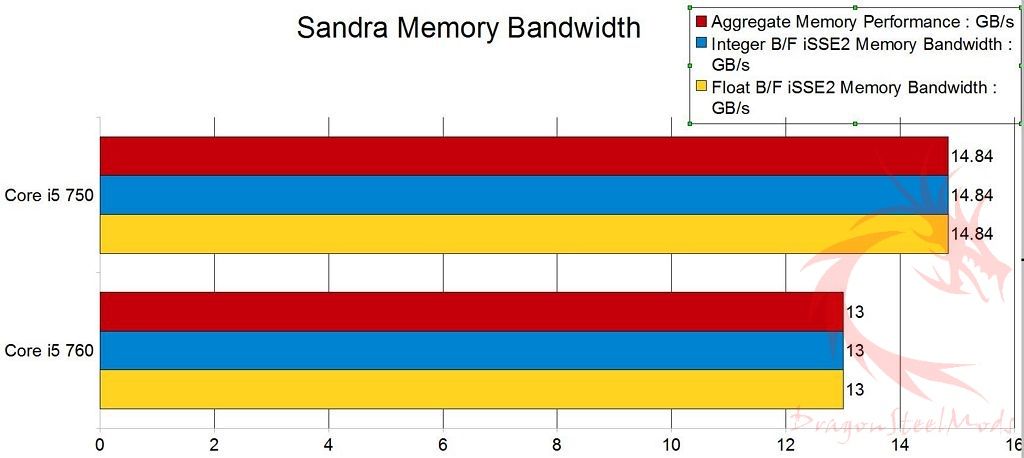
Hmm, here the i5-750 does better, but not by much really.
Then for the last test we have the Memory Latency test:
Memory Latency Test:
Benchmark the latency (response time) of processors’ caches and memory
The latency of caches is measured in processor clocks (i.e. how many clocks it takes for the data to be ready) as it is dependent on the processor clock speed.
The latency of memory is measured in nanoseconds as it is typically independent on processor clock speed.
Results Interpretation:
Latency: Lower is better
Speed Factor: Lower is better
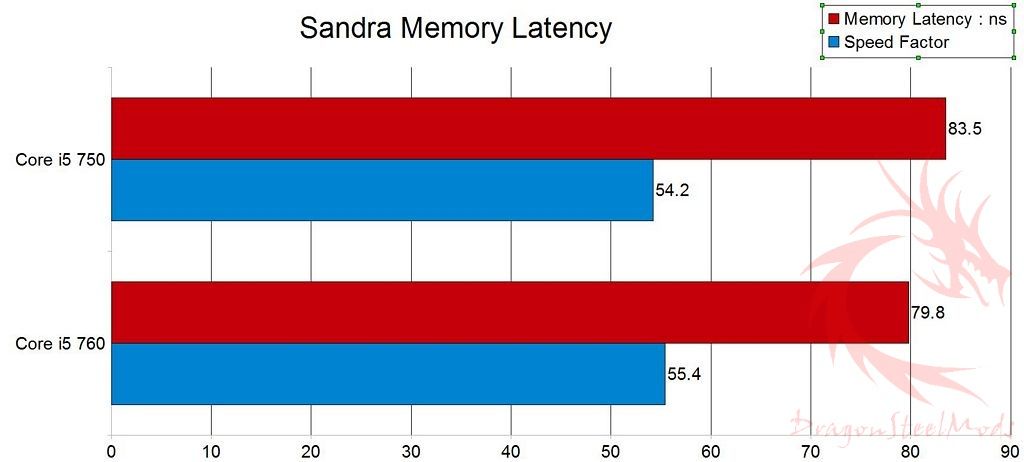
Lower scores are better here in this test and we see a mixed result with what I’d have to say the 760 doing slightly better overall in terms of latency which is the most important here I think.
I didn’t do much in terms of overclocking this CPU as it wasn’t mine and I didn’t want to mess with it too much. My 750 though easily hit 3.2Ghz from the stock 2.66Ghz with no effort, so I can see the 760 giving similar results on air.